
The HP Way
Hewlett and Packard believed great companies must stand for something bigger than profit. They created a clear vision that focused on innovation, long-term thinking, and meaningful contributions to society. This vision gave employees a sense of purpose and direction.
LEADERSHIPTEAM WORKVISION
Frank Ziovas
3/11/20265 min read
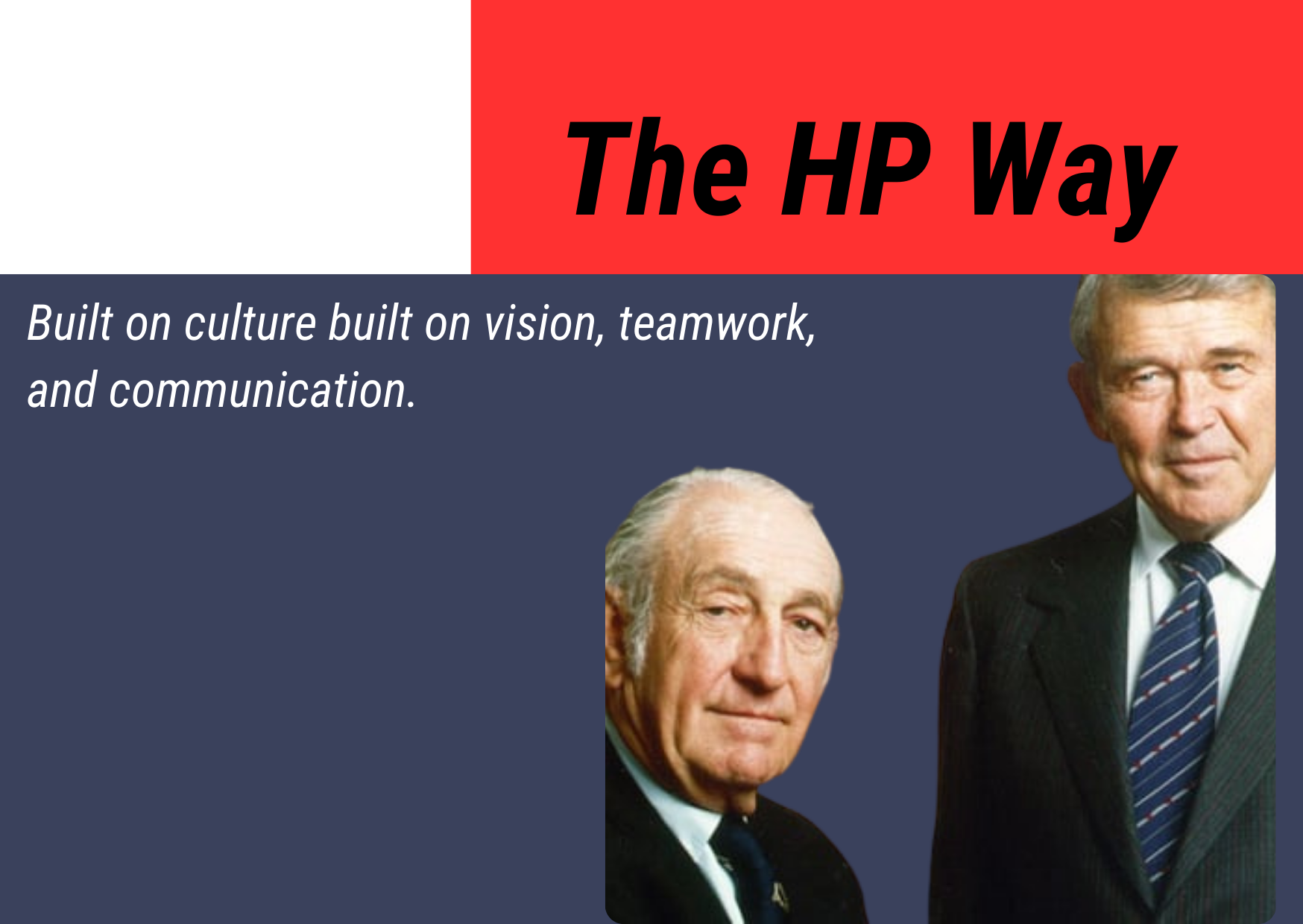
The HP Way: What One Company Taught the World About Leadership
If you study the history of great companies, you will notice something interesting. The organisations that truly shape industries are rarely built purely on strategy, technology, or capital. They are built on leadership philosophy. One of the most powerful examples of this in modern business history is what became known as “The HP Way.”
In 1939, two Stanford engineers, Bill Hewlett and Dave Packard, started a small company in a Palo Alto garage that would eventually grow into Hewlett-Packard. At the time, they had little capital, limited equipment, and no guarantee of success. What they did have, however, was a very clear idea of the kind of company they wanted to build. From the beginning, Hewlett and Packard believed that great companies were not defined only by the products they sold but by the values that guided the people inside them.
What made HP exceptional was not simply that it produced innovative technology. Many companies can invent great products. What made HP stand apart was that it built a culture where people could think, collaborate, and innovate in ways that were rare for corporate America at the time. Over the decades, this philosophy became widely known as The HP Way, and it turned the company into one of the most respected organisations in the world. Leaders across industries studied it closely because it revealed something powerful: when vision, teamwork, and communication are deeply embedded into the DNA of an organisation, extraordinary things become possible.
The first cornerstone of the HP Way was vision. Hewlett and Packard never believed their company existed merely to generate profit. While financial success was obviously important, they believed that great organisations must contribute something meaningful to the world. Long before corporate mission statements became fashionable, HP developed a clear set of objectives that defined its purpose. The company aimed to create products that advanced technology while building an environment where employees could do their best work and grow professionally. This was a radical idea in the mid-20th century when many businesses viewed employees simply as labour.
That vision shaped every major decision the company made. Instead of chasing short-term gains, HP invested heavily in research and development. Engineers were encouraged to experiment, take risks, and explore new ideas. Failure was not punished but treated as part of the learning process that leads to innovation. Hewlett and Packard understood that true breakthroughs rarely come from rigid systems or fear-driven environments. They come from organisations where people feel trusted to think creatively and push boundaries.
As a leader today, this is an important lesson for you. Too many organisations operate without a clear long-term vision. Teams move from project to project without understanding the larger purpose behind their work. When people lack a sense of direction, they become disengaged, reactive, and disconnected from the company’s mission. Great leadership begins with clarity. Your team needs to know where they are going and why their work matters. Vision creates momentum because people naturally commit themselves to goals that feel meaningful and worthwhile.
The second defining element of the HP Way was teamwork. Hewlett and Packard believed that great companies are built not by a handful of executives but by the collective intelligence of the entire organisation. They understood something many leaders forget: talent alone does not create success. What matters is how well talented people work together.
In the early years of HP, corporate hierarchies were common. Executives often worked behind closed doors while employees followed instructions from above. Hewlett and Packard rejected that model. They created an environment where communication flowed freely across levels of the organisation. Managers worked closely with engineers, ideas were encouraged regardless of job title, and employees were invited to contribute to the company’s direction. This sense of shared ownership built a culture where people felt respected and valued.
One of the most famous leadership practices that emerged from HP was what became known as “management by walking around.” Instead of relying solely on reports or meetings, leaders spent time on the floor with employees. They talked with engineers, listened to ideas, observed operations, and built personal relationships with the people doing the work. This simple practice created an environment of trust and transparency that strengthened collaboration across the company.
When leaders remain accessible and engaged, teams feel empowered to speak openly about problems and opportunities. Innovation flourishes because ideas can surface from anywhere within the organisation. Employees become invested in the success of the company because they feel like partners in the journey rather than spectators following orders. That sense of ownership is one of the most powerful forces in business, and Hewlett and Packard understood how to cultivate it.
The third pillar of the HP Way was communication. Vision and teamwork cannot function without clear, consistent dialogue between leaders and employees. Hewlett and Packard believed that communication was not simply about delivering instructions; it was about creating understanding. They wanted employees to know what the company was doing and why those decisions mattered.
Transparency was a defining feature of HP’s leadership style. Information about strategy, performance, and challenges was shared openly. Leaders explained decisions rather than hiding behind authority. Employees were encouraged to ask questions and express ideas. This level of openness created alignment across the organisation. When people understood the bigger picture, they were able to make smarter decisions in their own roles without waiting for constant direction.
In many companies today, communication breaks down because information becomes trapped within leadership circles. Strategies are discussed in executive meetings but never clearly explained to the people responsible for execution. Employees carry out tasks without understanding how their work contributes to broader goals. Over time, this disconnect leads to confusion, frustration, and declining performance. The HP Way demonstrated that effective communication is not a luxury in leadership—it is the glue that holds an organisation together.
Beyond vision, teamwork, and communication, Hewlett and Packard built something even more powerful: a strong organisational culture. Culture is often described as the invisible force that shapes how people behave inside a company. It influences decision-making, collaboration, and accountability in ways that cannot be dictated through policies alone. At HP, culture was intentionally designed around values such as trust, respect, innovation, and integrity.
This culture became a competitive advantage that many competitors struggled to replicate. While other companies focused purely on products and profits, HP invested heavily in its people. Employees were treated with dignity and encouraged to grow professionally. Leadership emphasised long-term thinking rather than short-term gains. These values created an environment where employees felt motivated to contribute their best work.
The impact of this philosophy extended far beyond HP itself. The company played a major role in shaping the development of Silicon Valley and influenced countless technology firms that followed. Leaders throughout the world studied HP’s management approach because it demonstrated how powerful a well-designed culture could be. The company proved that businesses could achieve both financial success and a strong ethical foundation.
For you as a leader, the HP Way offers a timeless blueprint. The tools and technologies we use today may be different from those of Hewlett and Packard’s era, but the principles that drive human performance remain unchanged. People still want to work for organisations that have a clear purpose. They still thrive in environments built on trust and collaboration. And they still perform at their best when leaders communicate openly and consistently.
Leadership is not about authority or titles. It is about creating an environment where people can succeed together. Hewlett and Packard understood that truth long before leadership became a popular topic in business literature. They built a company where vision inspired direction, teamwork created strength, and communication built alignment.
That philosophy became known as the HP Way. And decades later, its lessons remain just as relevant for leaders who want to build organisations that endure.
Address
Suite 172, 139 Cardigan Street, Carlton Victoria, Australia 3053
Contacts
+61 3 70545000
frank@alfaconsultingservices.com.au
Alfa Consulting Services
Developing effective leaders, streamlined systems, and high-performing teams.
"Leadership is the discipline of building something that performs even when you are not in the room."