New: The Leadership Playbook is now available. A practical framework for building stronger leaders, better teams, and lasting business performance.
“The AC Milan Leadership Lesson: How Great Organisations Lose Their Identity — And How Real Leaders Rebuild It.”
If you believe leadership is mostly about spreadsheets, KPIs, and chasing short‑term wins, the story of AC Milan should challenge that belief immediately. What weakened Milan was not a shortage of money, talent, or supporters. The real damage came from something far more dangerous: leadership that slowly lost sight of what made the organisation great in the first place.
TEAM WORKVISIONLEADERSHIP
Frank Ziovas
3/11/202613 min read
If you believe leadership is mostly about spreadsheets, KPIs, and chasing short‑term wins, the story of AC Milan should challenge that belief immediately. What weakened Milan was not a shortage of money, talent, or supporters. The real damage came from something far more dangerous: leadership that slowly lost sight of what made the organisation great in the first place.
Introduction
Leadership failure rarely arrives with noise or chaos. More often it appears quietly. It shows up disguised as strategy, supported by numbers, and justified as necessary progress. By the time performance collapses, the real damage has already happened. Identity has been stripped away, culture has been hollowed out, and standards have slowly been lowered.
AC Milan offers a powerful case study that every serious leader should examine. Not because of nostalgia for football, but because it reflects a pattern that appears in businesses and institutions across the world. The story is not really about tactics, formations, or transfer decisions. It is about leadership, culture, and the choices leaders make when pressure begins to build.
Read this not as a football supporter, but as a leader looking for a clear reminder of what sustains greatness and what slowly destroys it from within.
AC Milan is more than a football club. It is a global institution shaped by decades of excellence, identity, and influence. Nineteen Serie A titles and seven Champions League trophies place the club among the most successful organisations in the history of sport. But the numbers only tell part of the story. Milan built a reputation that stretched far beyond Italy—its influence reached across Europe, South America, Asia, and every corner of the football world where the red and black badge carried meaning. For generations of supporters, players, and managers, Milan represented a standard of professionalism and ambition that others tried to emulate. For decades the club did not chase relevance or attention; it defined what elite football looked like and forced the rest of the sport to measure itself against that benchmark.
That level of dominance was not accidental. It was built on clarity, the kind of clarity that very few organisations ever achieve. Everyone inside Milan understood what the club stood for and what was expected of them. Clear expectations meant players knew the standard required to wear the shirt. Clear identity meant every decision, from recruitment to tactics to leadership appointments, reinforced what Milan represented. And clear leadership ensured those standards were protected when pressure arrived. When an organisation reaches that level of alignment, performance stops being random and starts becoming repeatable.
Inside the club, the objective was simple: be the best. Not merely competitive. Not comfortably sustainable. The best. Everyone connected to Milan understood that standard.
Great Organisations Are Built on Identity, Not Tactics
At its peak Milan achieved something that most organisations struggle to create: alignment. Leadership, culture, recruitment, and performance all moved in the same direction. Players understood the meaning behind the badge. Coaches recognised the expectations. Executives protected the DNA of the club.
That alignment produced more than trophies. It created continuity and stability. Then came 2012.
Financial Fair Play rules reshaped the landscape of European football almost overnight. Clubs were suddenly forced to operate under tighter financial structures, and the margin for poor planning disappeared. For organisations with clear strategy and disciplined leadership, the rules created stability. For others, they exposed weaknesses that had previously been hidden behind spending power.
At the same time, AC Milan entered a period of uncertainty at ownership level. Silvio Berlusconi, who had overseen decades of dominance, gradually reduced the level of financial commitment required to keep Milan operating at the summit of European football. The club that once set the standard for ambition and competitive excellence suddenly began operating with hesitation.
When leadership hesitation enters an organisation that was built on certainty, the consequences are inevitable. Investment slows. Recruitment becomes cautious rather than decisive. Strategic direction becomes blurred. And slowly, the gap between what the organisation once was and what it is becoming begins to widen. The effects were predictable.
Standards began to slip. What had once been non‑negotiable expectations slowly became flexible guidelines. Players who would never have met Milan's historical standards suddenly became acceptable simply because the club needed bodies rather than excellence. Decision‑making also shifted. Instead of long‑term strategic thinking, leadership began reacting to circumstances—short‑term fixes replacing deliberate planning. And as those compromises accumulated, something even more dangerous happened: the club's identity slowly began to fade. What Milan stood for became less clear, both inside the dressing room and across the football world.
Milan did not collapse in a dramatic moment. There was no single headline that announced the fall, no obvious crisis that forced immediate action. Instead, the decline unfolded gradually. Small compromises were made. Standards softened slightly. Decisions that once would have been rejected were quietly accepted because they seemed convenient at the time.
This is how most great organisations decline — not through sudden disaster, but through slow drift. Drift happens when leaders stop defending the standards that once defined excellence. It happens when urgency replaces discipline and when short‑term fixes begin to substitute long‑term thinking.
Left unchecked, drift becomes dangerous because it is easy to rationalise. Results might still look acceptable for a while. The organisation may still appear successful from the outside. But internally, the foundations are weakening. Culture loses its sharpness, identity becomes blurred, and the competitive edge that once separated the organisation from everyone else slowly disappears.
Leadership Returns, And So Does Success
When Elliott Management took control, something important returned to Milan: competence.
Rather than chasing headlines or marketing moments, the new ownership focused on something far more important: competence and credibility. They installed leadership with genuine football understanding and deep cultural awareness of what AC Milan represented. Under Ivan Gazidis, Paolo Maldini, and Frederic Massara, the club rebuilt its leadership spine first before trying to rebuild the squad. Decisions became calmer, more deliberate, and aligned with a long‑term vision rather than short‑term noise. Recruitment focused on hungry players who fit the culture rather than expensive names designed to generate publicity. Young talent was developed with patience, veterans were chosen for leadership qualities, and the dressing room slowly rediscovered a sense of collective purpose. In many ways the rebuild resembled how great organisations recover after periods of instability: they restore leadership credibility, clarify standards, and rebuild trust internally before expecting results externally. Step by step, Milan began to rebuild its foundations.
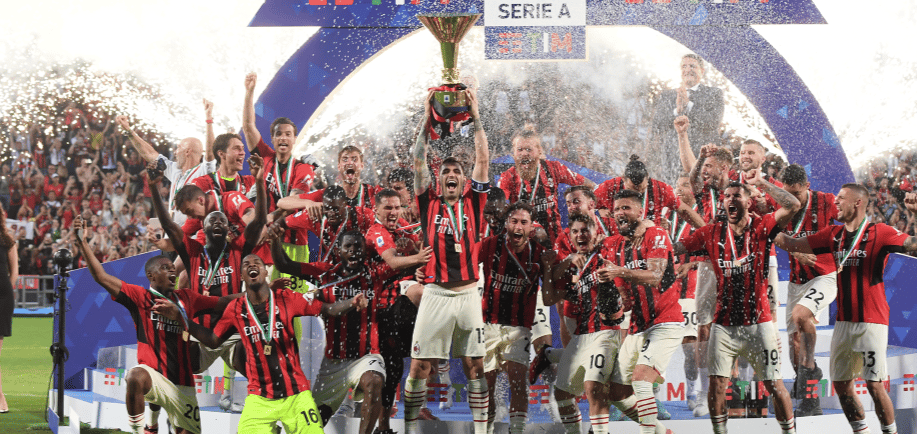
The results followed quickly. But the 2022 Scudetto was more than a football achievement — it was a leadership victory. Milan did not win the title with the most expensive squad in Italy or with a team filled with global superstars at their peak. They won because the organisation had rebuilt alignment. Leadership created clarity, the coaching staff built belief, and the players bought into a collective standard that placed the team above individual status. Discipline, unity, and shared responsibility became the competitive advantage. In leadership terms, the title represented the visible outcome of something deeper: a culture that had been restored and a group that trusted the direction of the organisation again.
A Serie A title after years away from the summit. A return to the Champions League semi‑finals. A squad assembled with purpose rather than hype.
Why did the turnaround happen?
Because Milan did not attempt to reinvent itself. Instead, it reconnected with its identity.
Paolo Maldini represented that identity perfectly. His presence inside the organisation carried authority, credibility, and standards that could not easily be replicated. Maldini was not simply another executive sitting in an office making strategic decisions; he was the living memory of what AC Milan had been at its very best. Having spent his entire playing career at the club, winning multiple Champions League titles and captaining some of the greatest teams in football history, he carried a level of moral authority that few organisations are fortunate enough to possess.
Inside the club, Maldini functioned as a cultural compass. When decisions were made about recruitment, behaviour, professionalism, or expectations, his perspective was shaped by decades of experience operating at the highest level. Players knew that when Maldini spoke, he was not repeating management theory or corporate language — he was speaking from lived experience.
Culture was no longer something written on a wall or printed in a handbook. It was visible every day in the way the club operated: in the discipline expected at training, in the professionalism demanded from players, and in the quiet but unmistakable message that wearing the Milan shirt meant carrying responsibility. Maldini's presence reinforced a simple but powerful idea — standards are not declared, they are demonstrated.
The Leadership Foundations That Built Milan
To understand why Milan's decline mattered so much, leaders must first understand what made the organisation extraordinary in the first place. During the Berlusconi era, AC Milan was not simply successful—it was structurally superior. Silvio Berlusconi approached the club with the mindset of someone building a world‑class organisation rather than merely owning a sports team.
He invested heavily, but money alone was never the secret. What separated Milan from competitors was the structure around the team: visionary leadership, elite coaching minds, and a culture that demanded excellence every single day. Berlusconi surrounded the club with capable operators and allowed football people to shape football decisions.
Under that environment, legendary managers such as Arrigo Sacchi and later Carlo Ancelotti built teams that changed how the game itself was played.
Sacchi’s Milan in the late 1980s was revolutionary. His teams pressed as a unit, defended collectively, and attacked with synchronised precision. It was not just tactical brilliance—it was organisational discipline. Every player understood their role. Every movement was connected. The system worked because everyone believed in the same vision.
This is where the leadership lesson becomes obvious. Sacchi was not simply coaching tactics. He was building alignment. The players, staff, and leadership all believed in a shared standard of excellence.
Carlo Ancelotti later inherited that foundation and evolved it. His leadership style was calmer, more relational, but equally powerful. Ancelotti created an environment where world‑class personalities—Maldini, Pirlo, Kaká, Shevchenko, Nesta, Gattuso, Seedorf—could perform together without ego destroying the system. He balanced authority with trust.
Great leaders know when to impose structure and when to allow talent to breathe. Milan succeeded because both approaches existed within the same culture.
Maldini — The Living Standard
No figure represents Milan's culture more clearly than Paolo Maldini. For over two decades he embodied what the club expected from its players: professionalism, discipline, humility, and absolute commitment to the badge.
Maldini was not loud. He did not seek headlines. Yet his influence inside the club was enormous because he represented continuity. Young players arriving at Milan did not need a handbook to understand expectations. They simply looked at Maldini.
When he later returned to the club as an executive, that same presence carried weight. His authority did not come from a job title. It came from decades of credibility.
This is one of the most overlooked truths about leadership: culture is transmitted through people, not policies. Remove those people without replacing the cultural authority they carry and the organisation weakens immediately.
The Corporate Parallel
What happened at Milan mirrors what happens in corporations around the world.
Many organisations reach the top through strong leadership, disciplined culture, and clear identity. Over time, however, new leadership sometimes arrives that prioritises financial engineering, quarterly performance, or rapid restructuring over institutional memory.
When that happens, the same pattern emerges:
Experienced leaders are replaced by operators who understand numbers but not culture.
Short‑term efficiency replaces long‑term capability.
Identity becomes diluted as organisations chase trends rather than protecting what made them successful.
You see this pattern in global corporations that once dominated their industries before slowly losing direction. The problem is rarely a lack of intelligence or resources. The problem is leadership forgetting the principles that created success in the first place.
AC Milan simply provides a visible and dramatic example of this phenomenon.
The Fatal Leadership Mistake, Then the trajectory shifted again.
RedBird Capital Partners made the decision to remove Paolo Maldini from the club, a move that, while framed publicly as a structural change, carried far deeper consequences for the organisation's internal culture and leadership continuity.
From a distance it may have looked like a standard business decision, the kind boards make every day in the name of structure, efficiency, or strategic direction. Ownership groups often view organisations through financial statements, performance dashboards, and operational frameworks. Within that lens, individuals can appear interchangeable, and leadership roles can seem replaceable as long as the structure remains intact.
But culture does not operate on spreadsheets.
Inside the organisation, the impact was far deeper. Removing Maldini meant removing one of the strongest cultural anchors Milan possessed. Leaders like Maldini carry something that cannot easily be quantified: institutional memory, credibility with players, and the authority that comes from lived experience inside the organisation. Boards and ownership groups frequently underestimate this kind of leadership capital because it rarely appears in reports or quarterly updates.
Cultural leaders do not simply perform a job function. They stabilise organisations during uncertainty, transmit standards to new generations, and act as a bridge between the past identity of an institution and its future direction. When those individuals disappear, the vacuum they leave behind is rarely visible immediately. But over time the consequences begin to surface, decision‑making loses context, standards become negotiable, and the subtle behavioural cues that once reinforced culture begin to fade.
Once that anchor disappeared, a series of problems followed.
Key players were sold without equivalent replacements, weakening the competitive spine that had only recently been rebuilt. Recruitment began to lose strategic coherence, with signings that appeared driven more by opportunity and financial logic than by a clearly defined football philosophy. Managerial decisions also began to look increasingly disconnected from Milan's identity, creating uncertainty about the direction of the club both inside the dressing room and among supporters.
These were not isolated mistakes. They were symptoms of leadership losing touch with culture.
When leadership disconnects from culture, culture does not fight back loudly. Instead it slowly withdraws. And when culture retreats, performance inevitably declines.
This Story Is Not Really About Football
Whether you run a company, lead a team, or manage an organisation, Milan's experience offers important lessons.
First, protect the people who carry your culture.
Every strong organisation has individuals who embody its values through their behaviour, decisions, and standards. These are the people who quietly reinforce what the organisation stands for every day. They act as cultural anchors, reminding new employees what excellence looks like and ensuring standards do not erode when pressure rises. Remove them carelessly—or fail to replace them with leaders who carry the same authority—and the organisation loses more than a person. It loses memory, credibility, and the living example of what the culture is supposed to be.
Every strong organisation has individuals who represent its values. When those people disappear without thoughtful succession, the organisation creates a leadership vacuum. Confusion quickly fills that space.
Second, short‑term profit is not a long‑term strategy.
Selling assets or cutting capability may improve financial optics temporarily, but it rarely strengthens the organisation. Financial discipline matters, but when cost reduction becomes the primary strategy, organisations slowly hollow themselves out. Capabilities disappear, experienced people leave, and the systems that once supported performance begin to weaken. For a short period the numbers may look healthier, but beneath the surface the organisation becomes less capable of competing.
Sustainable success requires reinvestment — not just financially, but strategically. Leaders must continually invest in talent that raises standards, systems that support execution, and cultures that reinforce accountability. Strong organisations understand that profitability and capability must grow together. When one grows at the expense of the other, decline eventually follows.
Third, alignment is more powerful than raw talent.
Organisations often believe that hiring the most talented individuals will automatically produce great results. In reality, talent without alignment often creates friction rather than performance. Even brilliant people struggle when they operate inside systems that lack clarity, shared standards, or a common direction.
Alignment works through three critical forces.
First, clarity of purpose. People perform best when they understand exactly what the organisation is trying to achieve and how their role contributes to that mission. Without that clarity, even highly capable individuals begin to pull in different directions.
Second, shared standards. High‑performing organisations establish clear behavioural and performance expectations that apply to everyone. When standards are consistent, talent amplifies performance. When standards are inconsistent, talent often becomes fragmented and individualistic.
Third, leadership consistency. Leaders must reinforce the same values through their decisions, behaviour, and communication. If leadership sends mixed signals, even the most talented teams begin to lose trust in the system.
When these three elements align—purpose, standards, and leadership—talent becomes a multiplier of performance. But when alignment disappears, talent alone cannot save the organisation. In fact, the greater the talent, the greater the frustration becomes when individuals feel they are operating inside a system that lacks direction.
That is why the most successful organisations focus on alignment first and talent second. Talent wins games. Alignment wins championships.
The Question Every Leader Must Ask
The real lesson from Milan's rise, fall, and recovery is uncomfortable but essential for anyone responsible for leading people or building organisations.
Are you building something designed to endure, or are you quietly dismantling it while convincing yourself the numbers look acceptable?
Many leaders believe performance is driven primarily by financial management, operational efficiency, or clever strategy. Those things matter, but they are not the foundation of greatness. Great organisations are built on identity, protected by culture, and sustained by leaders who understand that standards must be defended every single day.
AC Milan's history shows this with brutal clarity. When leadership protected the club's identity, Milan dominated world football. When leadership drifted away from those standards, decline followed quickly. The difference was not talent, money, or fan support. The difference was leadership clarity.
Executive Conclusion
The executive lesson is simple, even if it is uncomfortable: organisations rarely collapse because of external pressure. They collapse because leadership slowly weakens the standards that once made the organisation strong.
When leaders prioritise optics over substance, culture begins to erode. When short‑term decisions replace long‑term thinking, capability weakens. When cultural carriers are removed without thoughtful succession, identity disappears.
And once identity disappears, performance becomes inconsistent, trust begins to erode, and the organisation loses the internal discipline required to compete at the highest level.
Great leaders understand something many managers do not: culture is not a slogan and identity is not a marketing message. They are strategic assets. Protect them, and organisations become resilient. Neglect them, and even the most successful institutions eventually decline.
The Connection to Ascending the Leadership Ladder
These lessons sit at the heart of the leadership philosophy explored in Ascending the Leadership Ladder: Transformational Leadership from the Football Pitch to the Boardroom.
Transformational leadership is not about authority or position. It is about building systems, culture, and alignment that allow people and organisations to perform at their highest level over long periods of time.
The five pillars of that framework — vision, culture, decision‑making, resilience, and influence — are visible throughout Milan's story.
Vision created clarity during the club's greatest eras.
Culture was embodied by leaders like Paolo Maldini who carried the standards of the organisation.
Decision‑making determined whether Milan protected its identity or drifted away from it. Resilience allowed the club to rebuild after periods of decline. And influence, the ability of leaders to shape behaviour, belief, and performance — determined whether the organisation moved forward together or fragmented under pressure.
The lesson is clear.
Leadership is not tested when things are easy. It is tested when pressure rises, when results fluctuate, and when leaders must choose between protecting the identity of the organisation or compromising it for convenience.
AC Milan's story reminds us that greatness is never permanent. It must be protected, reinforced, and renewed by leaders who understand what made the organisation great in the first place.
That is the real challenge of leadership.
Not building success once. But building systems, culture, and people strong enough to sustain it.
Author Note
This article reflects the leadership philosophy behind Alfa Consulting Services. Through Alfa Consulting, Frank Ziovas works with founders, executives, and leadership teams to strengthen organisational clarity, rebuild high‑performance cultures, and install practical leadership systems that drive long‑term results.
The focus is simple: align vision, strengthen culture, tighten decision‑making, and build leadership structures that allow organisations to scale without losing their identity. Whether advising growing companies or mentoring leadership teams, the objective remains the same — build organisations that perform today while remaining strong enough to endure tomorrow.
Because in business, just like in elite sport, success is never an accident. It is the result of disciplined leadership, clear standards, and systems designed to last.

Address
Suite 172, 139 Cardigan Street, Carlton Victoria, Australia 3053
Contacts
+61 3 70545000
frank@alfaconsultingservices.com.au
Alfa Consulting Services
Practical leadership solutions that develop people, strengthen teams and deliver lasting results.
"Leadership is the discipline of building something that performs even when you are not in the room."
Follow on